
Anterior Cervical Discectomy and Fusion (ACDF)
Relieve pressure. Stabilize your spine. Get back to your life.
An ACDF is a fusion procedure where damaged herniated disc and arthritic bone is removed and substituted with a spacer. This is meant to remove the pressure off the nerve and spinal cord and combining the vertebrae from above and below.
This can be done at 1 or multiple levels.
What is the difference between ACDF and cervical disc replacement?
Both procedures remove the damaged disc and decompress the nerves or spinal cord. With an ACDF, the disc space is stabilized and the two vertebrae eventually fuse together. With a cervical disc replacement, the damaged disc is replaced with an artificial disc designed to preserve motion at that level.
Neither procedure is universally better. Disc replacement is appropriate for carefully selected patients, while ACDF may be preferable when there is significant arthritis, instability, deformity, or other anatomy that makes disc replacement unsuitable.
-
After anesthesia is given, a ~2.5 inch incision is made on the front of the neck. The windpipe and esophagus is moved over the side, the injured disc is removed, and the nerves and spinal cord are carefully relieved of the damaging pressure.
The spacer is placed. This is repeated at multiple levels as needed. Sometimes a plate is placed on the front of the bone to stabilize.Intraoperative X-rays are done to confirm placement, and the wound is checked for bleeding and the incision is sutured closed.
-
Relieve nerve and spinal cord compression
Stabilize arthritis in neck
Achieve fusion to connect vertebrae through the disc space with the spacer
-
Some patients may require spending a night in the hospital after surgery.
Soreness from the incision site can remain for a week or two, along with hoarseness and some difficulty swallowing.The fusion may take 6-12 weeks to heal, as it takes time for the body to incorporate the bone graft.
Return to work times vary, some people are able to return to light work 2 week after surgery. For those with a very physically demanding job, return to work may not happen until at least 6 weeks after surgery. -
Decrease neck pain by at least half and decrease arm symptoms by at least 70%.
-
There is no surgery without risks. They include but are not limited to: failed fusion, bad reaction to anesthesia, injury to vocal cords, injury to esophagus, difficulty swallowing, surgical site infection, prolonged pain, nerve injury, spinal cord injury, spinal fluid leak, and the need for additional surgery.
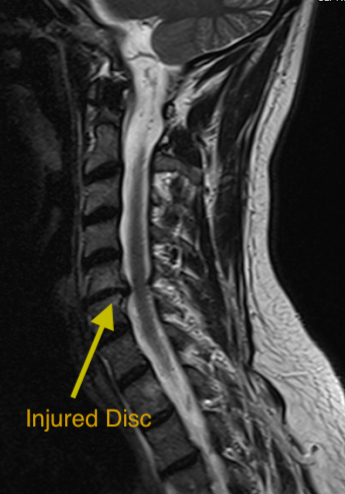
Injured Disc In Neck

ACDF Implant X-Ray in Neck
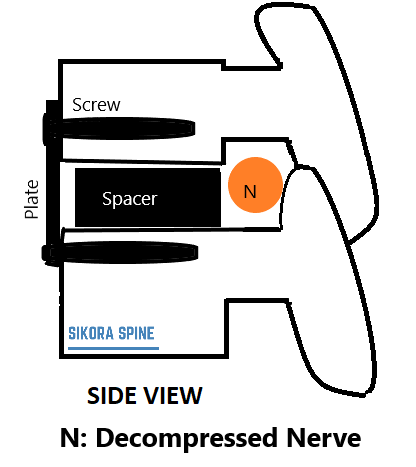
Drawing of Implant in Neck Showing Relief of Nerves

Drawing of Herniated Disc
FAQs
1. What is ACDF?
ACDF stands for anterior cervical discectomy and fusion. It is a surgery used to treat problems in the neck caused by a damaged or degenerated disc that is compressing a nerve or the spinal cord.
During surgery, the damaged disc is removed through a small incision in the front of the neck. The nerves and/or spinal cord are decompressed, and the space is filled with an implant that allows the two adjacent vertebrae to eventually grow together and form a solid fusion.
2. Why would I need ACDF?
ACDF may be recommended when a cervical disc herniation, bone spur, or other degenerative change is putting pressure on a nerve or the spinal cord.
Common symptoms include:
Shooting pain into the arm
Numbness or tingling
Arm or hand weakness
Persistent neck pain associated with cervical disc disease
Difficulty with balance or walking
Loss of hand coordination or dexterity
Surgery is generally considered when symptoms do not improve adequately with nonsurgical treatment or when there are significant or progressive neurologic problems.
3. Do I need surgery, or can my neck problem heal on its own?
Not everyone with a cervical disc herniation needs surgery. Many patients improve with time, medications, physical therapy, activity modification, and other nonsurgical treatments.
Surgery becomes more appropriate when symptoms persist despite reasonable nonsurgical treatment, significantly interfere with your quality of life, or when there is progressive weakness or significant spinal cord compression.
The decision should be based on your symptoms, examination, and imaging—not on an MRI alone.
4. How is ACDF surgery performed?
ACDF is performed under general anesthesia through a small incision in the front of the neck.
The damaged disc is carefully removed, along with any bone spurs or other material compressing the nerve or spinal cord. The disc space is then restored and filled with an implant designed to support fusion. A plate and screws may also be used to stabilize the segment.
Over time, bone grows across the disc space, connecting the two vertebrae into one solid segment.
5. Will ACDF relieve my arm pain, numbness, or weakness?
When these symptoms are caused by a compressed cervical nerve, ACDF can provide significant relief by removing the pressure from that nerve.
Arm pain often improves relatively quickly after decompression. Numbness and weakness may take longer because the nerve needs time to recover. The amount of recovery depends partly on how severely and how long the nerve was compressed.
If there has been permanent nerve damage, some symptoms may not completely resolve.
6. What is the difference between ACDF and cervical disc replacement?
Both procedures remove the damaged disc and decompress the nerves or spinal cord.
With ACDF, the disc space is stabilized and the two vertebrae eventually fuse together.
With cervical disc replacement, the damaged disc is replaced with an artificial disc designed to preserve motion at that level.
Neither procedure is universally better. Disc replacement is appropriate for carefully selected patients, while ACDF may be preferable when there is significant arthritis, instability, deformity, or other anatomy that makes disc replacement unsuitable.
7. How long does it take to recover from ACDF?
Recovery varies depending on the number of levels treated, your overall health, the severity of your symptoms, and the type of work or activities you want to return to.
Many patients are walking and performing light activities soon after surgery. Arm pain may improve quickly, while numbness, weakness, and spinal cord-related symptoms can take weeks or months to recover.
Your surgeon will provide specific guidance regarding driving, work, exercise, lifting, and other activities.
8. Will I have trouble swallowing after ACDF?
Temporary difficulty swallowing is common after anterior cervical surgery.
Patients may experience throat soreness, a sensation that something is stuck in the throat, or difficulty swallowing certain foods. These symptoms generally improve as the tissues around the esophagus recover.
Persistent or significant swallowing difficulties should be discussed with your surgeon.
9. What are the risks of ACDF?
ACDF is a well-established procedure, but like any surgery, it carries potential risks.
These include:
Infection
Bleeding
Nerve injury
Spinal cord injury
Persistent or recurrent symptoms
Difficulty swallowing
Hoarseness or voice changes
Failure of the bones to fuse
Hardware complications
Problems developing at other levels of the cervical spine
Need for additional surgery
Your individual risks depend on your diagnosis, the number of levels being treated, your overall health, and other factors.
10. Will ACDF limit my neck movement?
ACDF eliminates motion at the level that is fused, but most patients retain substantial overall neck movement.
For a one-level ACDF, there are studies showing there is no difference in range of motion when compared to those with a cervical disc replacement and those who have never had surgery.
The amount of motion lost depends on the number and location of levels that are fused. Many patients do not notice a significant limitation in their everyday activities after they have recovered.
If preserving motion is an important consideration, cervical disc replacement may be an alternative for appropriately selected patients.
Which surgery is right for me?
There isn't a single operation that is best for every patient. The important first step is determining what is causing your symptoms and whether the problem is coming from a nerve, spinal cord, disc, or another structure.
The goal is not simply to perform surgery—it is to choose the procedure that gives you the best chance of meaningful pain relief, neurologic recovery, and return to the activities you enjoy.