
Lumbar Disc Replacement (Arthroplasty)
Preserve motion. Treat the source of your back pain.
Lumbar disc arthroplasty, also called lumbar disc replacement (LDR), is an advanced surgical option for carefully selected patients with painful lumbar disc degeneration. Unlike spinal fusion, disc replacement is designed to remove the damaged disc while preserving motion at that level of the spine.
If you have persistent low back pain caused by a damaged lumbar disc, you may be a candidate for disc replacement.
-
Lumbar disc arthroplasty is a surgical procedure that replaces a damaged lumbar disc with an artificial disc.
The lumbar discs act as cushions between the bones of your spine. Over time, a disc can become damaged or degenerated, potentially causing persistent low back pain.
During disc replacement surgery, the damaged disc is removed and replaced with an artificial disc designed to:
Restore the height of the disc space
Maintain motion at the treated level
Reduce pain generated by the damaged disc
Allow you to return to an active lifestyle
Unlike a fusion, the goal of disc replacement is not to eliminate motion at the treated level.
-
After anesthesia is given, an incision is made on the front of the belly, location dependent on level of surgery.
The stomach and major vessels are moved over to the side, the injured disc is removed, and the nerves and spinal cord are carefully relieved of the damaging pressure. Often, a vascular surgery expert helps with the exposure of the front of the spine.
The implant is placed, with confirmation on intraoperative X-ray, in the middle between the vertebral bones. The wound is checked for bleeding and the incision is sutured closed. -
Relieve at least 50% of back pain
Relieve 70% of leg pain
Maintain motion in the lumbar spine
-
A lumbar fusion is an effective and safe procedure helps relieve back and leg pain. More recently, the disc replacement was introduced to maintain motion in the low back and decrease the stress that goes through the neighboring levels.
For certain problems including severe arthritis, a disc replacement cannot be performed and fusion is preferred.
For those that meet disc replacement criteria, recovery is quicker (return to sport/work), motion is preserved at the diseased level, and rates of additional surgery are lower. -
Most patients go home the stay 1 night in the hospital, sometimes 2.
Soreness from the incision site can remain for a week or two, and the low back can feel sore, but it’s a different type of discomfort that before surgery.Sometimes people can feel constipated or have issues passing gas after surgery due to the belly contents being moved for surgery.
Unlike a fusion, there is no waiting for bone graft to consolidate, which can take months.
Return to work times vary, some people are able to return to light work 2 week after surgery. For those with a very physically demanding job, return to work may not happen until 6 weeks after surgery. -
90% of patients have their back pain decrease by at least half
Increase in activity level,
Decrease leg symptoms by at least 70%.
-
There is no surgery without risks. They include but are not limited to: bad reaction to anesthesia, injury to the major vessels in the belly, injury to intestines, surgical site infection, prolonged pain, nerve injury, implant failure, spinal fluid leak, and the need for additional surgery.

Injured Disc in Low Back
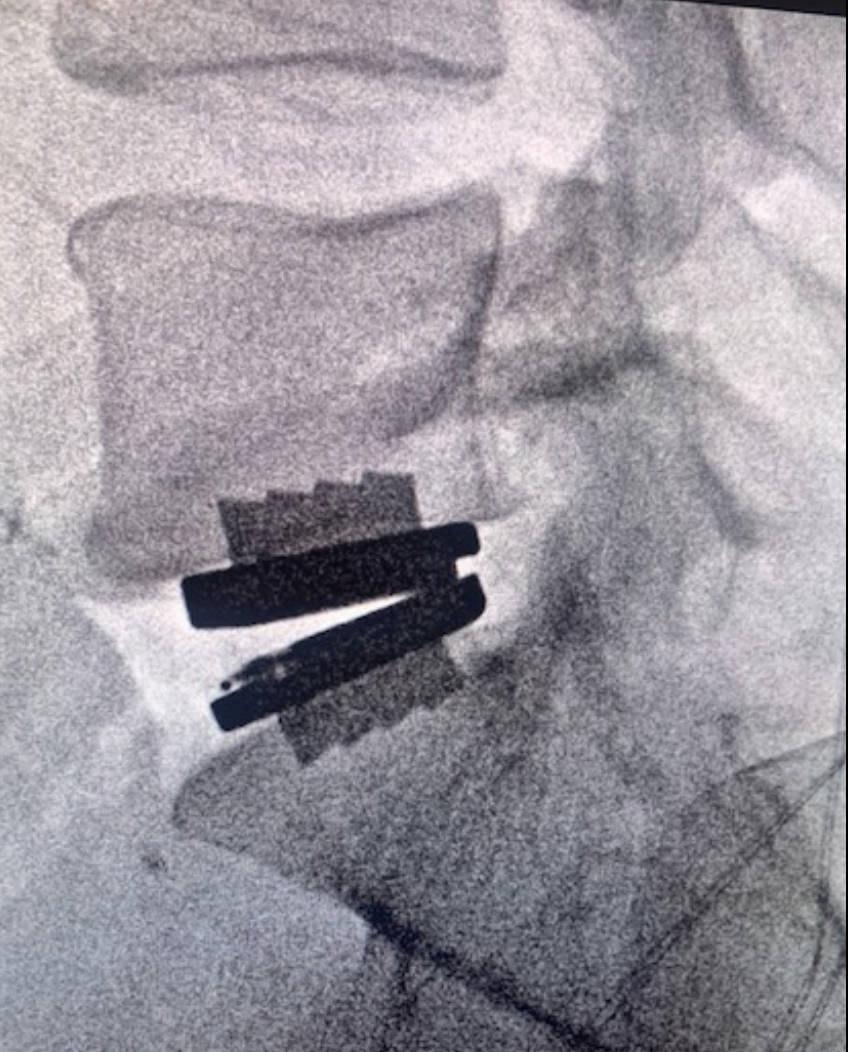
1 Level Disc Replacement Implant

2 Level Disc Replacement Implant
FAQs
1. What is lumbar disc arthroplasty?
Lumbar disc arthroplasty, also called lumbar disc replacement, is a surgery that removes a damaged lumbar disc and replaces it with an artificial disc. The goal is to relieve pain while preserving motion at that level of the spine.
2. How is a lumbar disc replacement different from a spinal fusion?
A fusion eliminates motion at the treated spinal level by joining two vertebrae together. Disc replacement is designed to preserve motion between the vertebrae. Both procedures can be effective, but they are appropriate for different patients.
3. Who is a good candidate for lumbar disc replacement?
Patients with carefully selected disc-related low back pain may be candidates. In general, the best candidates have pain coming from one or sometimes two lumbar discs, have not improved with appropriate nonoperative treatment, and do not have significant facet arthritis, spinal instability, severe spinal stenosis, or other conditions that would make disc replacement inappropriate.
4. What symptoms can lumbar disc replacement treat?
Lumbar disc replacement is primarily intended to treat discogenic low back pain. Some patients may also have pain that travels into the buttock or leg, but significant nerve compression may require a different surgical approach.
5. Can a lumbar disc replacement treat sciatica?
Sometimes, but it depends on the cause of the sciatica. If the primary problem is a herniated disc compressing a nerve, a microdiscectomy may be more appropriate.
6. How do you determine whether I am a candidate?
Evaluation typically includes your symptoms and medical history, a physical examination, and imaging such as X-rays and MRI. In some cases, additional testing may be helpful. The most important question is identifying where your pain is actually coming from and whether disc replacement is likely to address that source.
7. Do I need to try nonsurgical treatment first?
Yes. Physical therapy, activity modification, medications, and other appropriate nonsurgical treatments are generally attempted before considering surgery unless there is a compelling reason to proceed sooner.
8. Why is lumbar disc replacement performed from the front?
The lumbar disc is accessed through the abdomen rather than by removing the muscles and bones behind the spine. This allows the surgeon to remove the damaged disc and place the artificial disc directly into the disc space.
9. What are the advantages of lumbar disc replacement?
Potential advantages include relief of disc-related pain, preservation of motion at the treated level, and avoidance of creating a fusion at that level. In appropriately selected patients, disc replacement may also reduce the biomechanical changes associated with fusion.
10. Does disc replacement prevent adjacent segment disease?
It may reduce some of the biomechanical effects associated with fusion, but it does not guarantee that adjacent levels will never develop problems. Degenerative changes can occur naturally as we age.
11. How long does a lumbar disc replacement last?
Modern artificial discs are designed to be durable, but no implant lasts forever. Long-term studies continue to evaluate implant performance over decades. Your age, activity level, anatomy, and implant all influence long-term outcomes.
12. Can I return to sports after lumbar disc replacement?
Many patients are able to return to an active lifestyle after recovery. The timing and type of activities depend on your healing, symptoms, fitness level, and the specific procedure performed. High-impact or contact activities may require additional discussion with your surgeon.
13. How long does it take to recover?
Recovery varies from person to person. People spend up to one night in the hospital, walking the same day of surgery. Many patients are walking shortly after surgery and gradually increase their activity over the following weeks. Return to unrestricted activities is typically measured in weeks to months, rather than days.
14. Will I need physical therapy after disc replacement?
Some patients benefit from physical therapy to improve core strength, flexibility, body mechanics, and conditioning. The need for formal therapy depends on your individual recovery.
15. What are the risks of lumbar disc replacement?
As with any surgery, risks include infection, bleeding, blood clots, nerve injury, vascular injury, persistent pain, implant-related complications, and the possibility of needing additional surgery. Because the lumbar spine is approached from the front, there are also risks related to the blood vessels and abdominal structures.
16. Can the artificial disc move or fail?
Yes, although this is uncommon. An artificial disc can potentially wear, loosen, migrate, or develop other complications. Careful patient selection and proper implant positioning are important.
17. Can a lumbar disc replacement be converted to a fusion?
In some circumstances, yes. If an artificial disc develops a significant complication or the patient develops another problem requiring stabilization, revision surgery may involve removing the artificial disc and performing a fusion.
18. Can I have a disc replacement at more than one level?
Some patients may be candidates for two-level lumbar disc replacement, but candidacy depends heavily on the condition of each level and the health of the facet joints and surrounding spine.
19. Is lumbar disc replacement better than fusion?
Neither operation is universally "better." The right procedure depends on the patient's specific anatomy and source of pain. For carefully selected patients with disc-related pain, disc replacement can be an excellent option. Other patients are better treated with fusion, decompression, disc herniation surgery, or nonsurgical care.
20. When can I shower after a lumbar disc replacement?
Dr. Sikora uses waterproof bandage after surgery, so you can shower the same day of surgery.
21. What positions should I sleep in after surgery?
Whatever position you find comfortable is the right one. Some prefer on the side, some on the belly, some on the back; there is no one univeral position to sleep in. There are also risks specific to approaching the cervical spine from the front of the neck.
22. What is an “access” or “approach surgeon”?
Often when going through the belly for surgery, a well trained vascular/trauma surgeon will be there to expose the spine. In front of the spine, there are important intestinal/vascular (blood vessels and guts) that need to be managed and moved safely.
23. Why might my surgeon recommend a fusion instead of a disc replacement?
Disc replacement is not appropriate for every type of lumbar spine problem. Significant facet arthritis, spinal instability, spondylolisthesis, severe stenosis, osteoporosis, certain spinal deformities, or other conditions may make fusion a better option. The goal is not simply to preserve motion—it is to choose the operation most likely to address the underlying cause of your pain.