
Lumbar Microdiscectomy
A disc herniation occurs when a piece of disc bursts out of the disc space and presses on nerves.
A microdiscectomy removes the piece of disc from where it shouldn’t be (pressing on the nerve).
-
After anesthesia and local numbing medicine is given, an x-ray guided incision is made on the low back directly over the areas of nerve pinching.
Special retractors are placed, muscle and tissue is peeled off bone to get to the area of interest.A small amount of bone is removed, nerves are moved, and the disc herniation is revealed. This disc fragment is then removed.
The wound is checked for bleeding and the incision is sutured closed. -
Relieve pressure of the nerves in the low back that travel to the legs.
-
Patients go home the same day after surgery.
Soreness from the incision site can remain for a week or two. Muscles can spasm from surgery as they do not like getting pushed around. Nerve relief can be felt within days.
Nerves can be finicky, and there can be periodic pain episodes that happen due to nerve irritation from surgery.
Return to work times vary, some people are able to return to light work 1 week after surgery. For those with a very physically demanding job, return to work may not happen until 4-6 weeks after surgery. -
Relieve leg cramping and pain by releasing the nerve pressure.
Although it may relieve back pain, this may not happen and should not be expected.
Numbness may or may not improve, and if it does it may take up to 18 months.
-
There is no surgery without risks. They include but are not limited to: bad reaction to anesthesia, increase in low back pain, wound healing issues, surgical site infection, prolonged pain, nerve injury, creating instability in the spine, spinal fluid leak, and the need for additional surgery including fusion.

Disc Herniation MRI

PRE-OP of a Herniated Disc
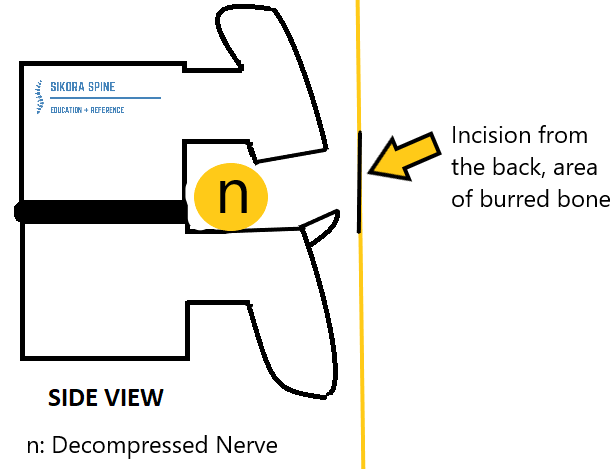
POST OP showing happy nerve
FAQs
Microdiscectomy
1.How long does surgery take?
The procedure typically takes about 45 minutes to an 1.5 hours, though total time at the hospital or surgery center is longer due to preparation and recovery.
2. What type of anesthesia is used?
General anesthesia is most commonly used, meaning the patient is completely asleep during the procedure. The patient has a tube in the mouth for breathing while laying on the stomach for the procedure.
3. How long is the recovery time?
Back to light activity: 2 days–2 weeks
Desk job: Often within 2–3 weeks
Manual labor/heavy lifting: Anywhere from 3-8 weeks, with surgeon clearance
Full recovery: Around 1.5-3 months, depending on the individual
5. Will the pain go away immediately?
Many patients experience immediate relief of leg pain, but it may take days to weeks for all symptoms to improve, including pain at the incision site. Numbness or tingling may take longer.
6. What are the risks of the surgery?
Infection
Dural tear (CSF leak)
Nerve injury
Recurrent disc herniation (5–10%)
Bleeding or hematoma (rare)
7. Will the disc re-herniate?
There is about a 5–10% chance of the disc re-herniating at the same level in the future, especially in younger, active patients.
8. Is physical therapy required after surgery?
Not always. Some patients recover well without formal PT, but others benefit from therapy starting around 4–6 weeks post-op, especially if weakness or deconditioning is present.
9. What activity restrictions will I have?
Minimize bending, lifting (>10 lbs), or twisting for the first 2 weeks
Walking is encouraged immediately
Avoid sitting for long periods during early recovery
Return to driving: Often 1–2 weeks, once off narcotics and able to move comfortably
10. Will this fix my back pain too?
A microdiscectomy is primarily done to relieve leg pain (sciatica). While some back pain may improve, it is not primarily a back pain surgery.
11. What do the first few days after surgery look like?
The first 1-3 days suck. The legs should feel much better, but the back will feel like it is stabbed. There will be muscle spasms and incisional pain, but then you turn the corner within days.